Flat Marker vs. Upright Headstone: Cost, Rules, and Style Comparison
By Remembrance Headstones12 min read
Flat grave markers typically cost $500 to $1,500. Many Sacramento-area cemeteries require them in lawn and garden sections. Your cemetery's section rules, budget, and preference for personalization are the three factors that determine which option is right.
What Is the Difference Between a Flat Marker and an Upright Headstone?
The most fundamental difference is orientation. Flat markers lie flush with or slightly above ground level, while upright headstones stand vertically on a horizontal base. Both styles are typically crafted from granite, which accounts for 43.6% of the global memorial market in 2026 (coherentmarketinsights.com), though bronze, marble, and slate are also used. In Sacramento cemeteries, the distinction matters immediately. Many newer memorial parks assign specific sections to each style. East Lawn Sacramento, Sacramento Memorial Lawn, and Elk Grove Cemetery each publish their own monument rules, and the section where a loved one is buried often determines which style is even permitted. Families who skip this step risk ordering a memorial that cannot be installed. That one check saves significant time and expense.
How Does a Flat Grave Marker Work?
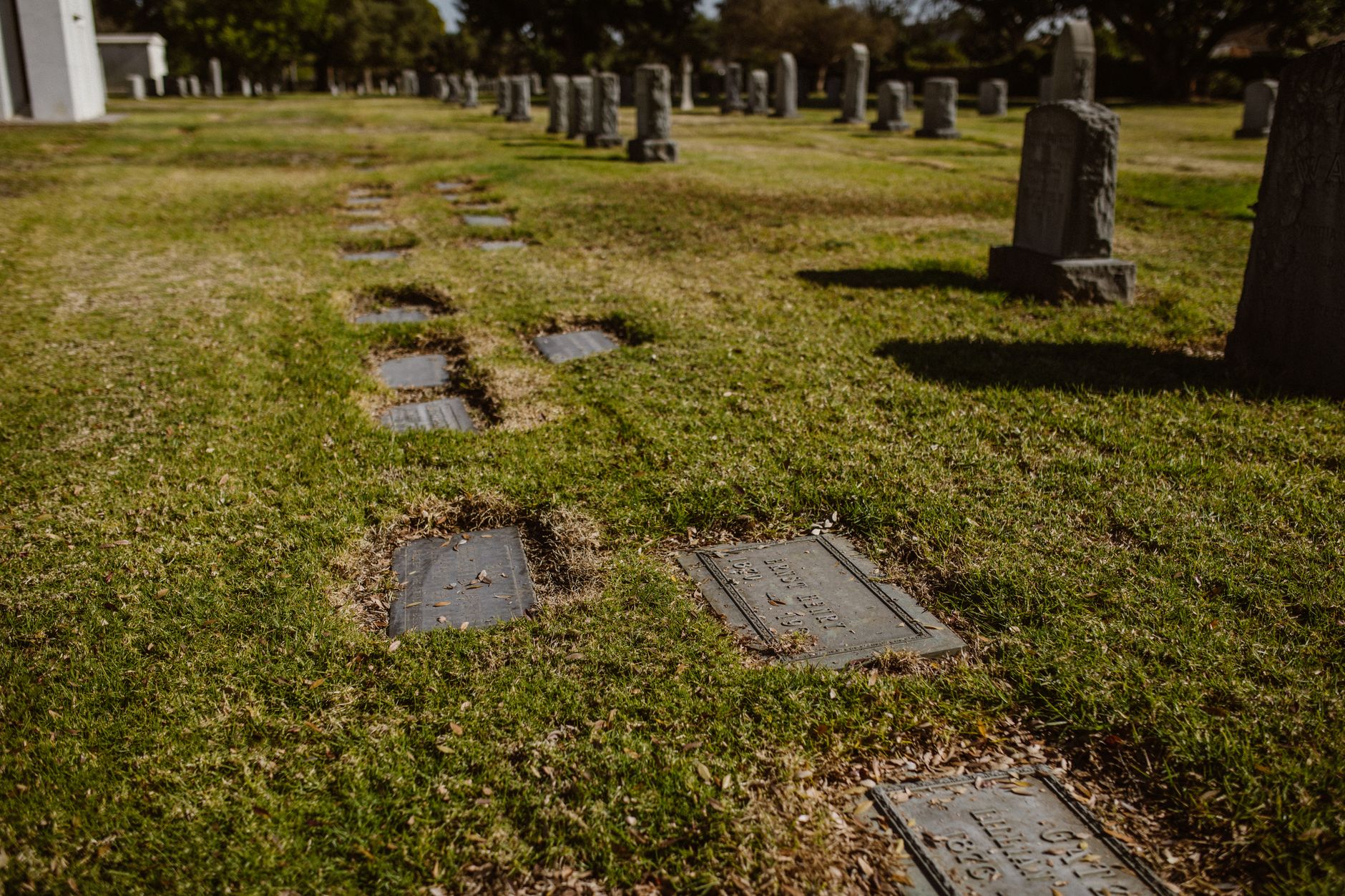
A flat grave marker is installed flush with or slightly raised above the turf, anchored in a concrete or granite base set below grade. This design allows grounds crews to mow directly over the marker without obstruction, which is precisely why so many Sacramento memorial parks designate entire sections as flat-marker-only zones. Standard granite flat markers typically measure 24x12 inches to 28x16 inches and are available as single or companion (double-width) styles. Bronze flat markers are mounted on a granite base called a die, combining the warmth of cast bronze lettering with the durability of a granite foundation. The installation footprint is smaller and the setting process less complex than for upright monuments, which contributes to the lower overall cost.
How Does an Upright Headstone Work?
An upright headstone consists of a vertical tablet, called the die, set on a horizontal base called the bottom or sub-base. Heights commonly range from 16 to 42 inches above the base, giving the memorial significant visual presence from a distance. Installation requires anchoring the base to a concrete foundation that meets cemetery specifications. Foundation requirements for upright headstones run deeper and wider than those for flat markers, adding both material cost and labor time. Cemeteries in Sacramento typically restrict upright headstones to traditional or unrestricted sections. Families must confirm section eligibility before placing any order. The larger surface area of an upright headstone makes it the preferred canvas for elaborate artwork, lengthy epitaphs, and custom carved shapes.
How Do Flat Markers and Upright Headstones Compare on Cost?
Cost is the most common deciding factor for Sacramento families comparing these two memorial styles, and the gap is real but not as wide as many people assume. A basic granite flat marker costs $500 to $1,500, while a standard 28x16-inch flat granite marker at a local dealer typically runs $1,500 to $2,500. Families should budget for a complete memorial. This includes the marker, foundation, setting fee, and engraving. Do not budget for just the stone itself. Across the US, a headstone usually costs between $500 and $5,000, with flat markers on the lower end and upright, companion, or custom monuments costing more. At Remembrance Headstones, we walk every family through a full cost breakdown before production begins so there are no surprises at the cemetery.
What Does a Flat Marker Cost in Sacramento?
Granite flat markers are the most accessible entry point for a permanent memorial in Sacramento. Small granite flat markers range from $995 to $1,750, while standard 24x12-inch markers run $1,295 to $2,000. Bronze and bronze-on-granite flat markers commonly range from $1,995 to $3,500 or more depending on size, cemetery rules, and customization. Companion flat markers for two individuals run $3,000 to $4,500 or more. Foundation costs for flat markers typically run $100 to $300, and cemetery setting or installation fees across the US generally add $200 to $800 depending on the cemetery and marker type. Engraving beyond the standard name and dates costs $15 to $18 per letter at many providers, so a longer epitaph adds up quickly. Laser-etched portraits and custom artwork typically add $300 or more per image.
What Does an Upright Headstone Cost in Sacramento?
Upright headstones carry higher costs because they require more granite volume, deeper foundation work, and more complex installation. Foundations for upright monuments can run $300 to $600, compared to $100 to $300 for flat markers. The type of granite also matters. Consider a Sacramento family choosing between a standard flat marker at $1,800 installed versus a single upright headstone at $3,200 installed. Both create a dignified memorial. The upright version delivers more engraving space and visibility, but the flat marker fully satisfies cemetery requirements in lawn sections and fits a tighter budget. Flexible financing can close that gap for families who prefer the upright style but need manageable monthly payments.
What Cemetery Rules Apply to Flat Markers and Upright Headstones in Sacramento?
Sacramento-area cemetery regulations are not uniform across the city or even across a single cemetery. Each property, including East Lawn Sacramento, Sacramento Memorial Lawn, and Elk Grove Cemetery, publishes section-specific monument rules that govern dimensions, materials, finishes, and installation procedures. California law requires cemeteries to provide families with a written copy of monument regulations upon request, so no family should have to guess. The critical point: rules vary by cemetery section, not just by cemetery. A single property may allow upright headstones in its older traditional sections and mandate flush flat markers in its newer garden sections. Ordering without confirming your specific section's rules is the most common and costly mistake families make in Sacramento. This is not a generic caution. Our team handles cemetery coordination regularly and sees section-specific conflicts arise more often than any other issue.
Why Do Some Cemeteries Require Flat Markers?
Flat markers are commonly used where cemetery rules favor a uniform lawn look, and the operational reason is straightforward. Lawn-level markers allow grounds crews to mow uniformly across large sections without steering equipment around vertical stones, which reduces labor costs and improves the overall appearance of the grounds. Most Sacramento memorial parks built after the 1950s adopted flat-marker-only policies in their newer sections as part of the garden cemetery design movement that swept the United States following World War II. The result is that many Sacramento families discover their loved one's burial section accepts only flush or slightly raised markers, ruling out upright headstones entirely. Older sections of the same properties often remain open to traditional upright monuments. Always verify section-specific rules before ordering any memorial, because even a well-crafted custom granite headstone cannot be installed if it violates the section's specifications.
What Dimensions and Materials Do Sacramento Cemeteries Typically Allow?
Granite is the universally accepted material across all major Sacramento-area cemeteries because of its hardness, weather resistance, and consistent availability in multiple colors. Minimum thickness for flat markers is typically 3 to 4 inches; upright dies often require a minimum 6-inch base. Bronze markers must meet industry manufacturing standards for alloy composition and mounting hardware. Some Sacramento cemeteries restrict available colors or require a specific finish, such as a polished top surface with rock-pitched sides, to maintain section uniformity. Veterans buried in Sacramento-area national or veterans sections follow VA National Cemetery Administration standards for marker size, granite type, and inscription content. Upright headstones placed in eligible sections must also meet weight limits to ensure the foundation can safely support the stone long-term. Working with a local monument provider who handles cemetery coordination directly protects families from these details becoming a burden.
How Do Flat Markers and Upright Headstones Compare on Design and Personalization?
Personalization is where upright headstones have a clear structural advantage, but flat markers are far more capable than many families assume. Upright headstones offer a large vertical canvas for artwork, epitaphs, photographic laser portraits, religious symbols, custom carved shapes, and decorative borders. Custom shapes such as hearts, crosses, book forms, and arched tops are signature features of upright monuments and are not typically available in flat-marker formats. Flat markers, by contrast, excel in simplicity and elegance. A polished granite surface with deep sandblast carving, contrast-polished lettering, and a laser-etched portrait creates a dignified and personalized tribute within the constraints of a ground-level format. Both styles support QR code memorial integration, where a weatherproof QR code embedded in the stone links visitors to a digital tribute page with photos, videos, and stories. Personalization that reflects the deceased's personality, faith, or hobbies is achievable in both formats. The difference is scale, not possibility.
Which Style Offers More Design Flexibility?
Upright headstones win on overall design flexibility due to greater surface area and three-dimensional form. A 24x18-inch upright face offers nearly twice the engraving surface of a standard flat marker, which translates directly to more room for detailed artwork, longer inscriptions, and complex motifs. Companion upright headstones with a shared base and two individual tablets are one of the most requested designs at Remembrance Headstones, particularly for married couples who want a single unified memorial that honors both individuals with distinct personal artwork on each side. Flat markers handle companion formats as well, using double-width stones that accommodate two names and dates side by side. Both styles accept laser-etched photographic portraits, which remain the most requested personalization feature across Sacramento families. 3D digital design previews allow families to visualize either style before production begins, which eliminates the fear of committing to a permanent design without seeing a realistic preview first. Design flexibility matters. So does peace of mind.
Flat Marker vs. Upright Headstone: Pros, Cons, and Final Verdict
Neither option is universally superior. The right choice depends on your cemetery section's rules, your budget, and how prominently you want the memorial to be visible. Flat markers suit lawn-section cemeteries, tighter budgets, and families who prefer a clean, understated aesthetic. Upright headstones suit families who prioritize visibility, design expression, and the traditional appearance of a vertical stone. Cost is real but not the whole story. Flexible financing makes upright headstones accessible to families who assume they are out of reach. Consulting with a Sacramento headstone specialist before purchasing prevents the most common and costly mistakes.
Comparison Table: Flat Marker vs. Upright Headstone
The table below summarizes the key differences across all major decision factors. Use it as a quick reference alongside the detailed sections above.
| Factor | Flat Grave Marker | Upright Headstone |
|---|---|---|
| Typical Cost Range | $500 to $2,500 (granite) | $1,000 to $5,000+ |
| Foundation Cost | $100 to $300 | $300 to $600 |
| Cemetery Setting Fee | $200 to $800 | $200 to $800 |
| Cemetery Compatibility | Required in lawn/garden sections; accepted everywhere | Permitted in traditional or unrestricted sections only |
| Design Surface Area | Limited (24x12 to 28x16 inches typical) | Large (vertical face plus base) |
| Personalization Options | Portraits, color fill, borders, QR codes | Custom shapes, large artwork, epitaphs, QR codes |
| Visibility from a Distance | Low (ground level) | High (stands 16 to 42 inches tall) |
| Maintenance Required | Minimal; mowers pass over without obstruction | Periodic cleaning; inspect base annually |
| Material Options | Granite, bronze on granite | Granite, marble, slate |
| Companion / Double Style | Yes, double-width side by side | Yes, companion tablet or double-wide base |
| Best For | Lawn-section cemeteries, modest budgets, clean aesthetic | Traditional look, more engraving space, visible tribute |
Which Should You Choose for a Sacramento Cemetery?
Start by confirming your specific cemetery section's monument rules before making any decision. If the section permits both styles, consider how prominently you want the memorial to be visible from a walking path or from the road. A flat marker lies quietly at ground level. An upright headstone commands attention from across the lawn. Families on a strict budget can achieve a dignified, personalized memorial with a quality granite flat marker. Families seeking a statement piece, more engraving space, or a traditional vertical tribute should favor an upright headstone and explore financing options if cost is a concern. Pre-need purchases allow families to lock In the current pricing against future increases, which matters given that traditional full-service burial costs in California have reached $8,039 or more (us-funerals.com). Work with a provider who offers 3D digital design previews so you can see your choice before it is carved in granite.
Pros and Cons: Flat Grave Marker
- Pros: Lower cost entry point, accepted in all cemetery sections including lawn-only zones, minimal long-term maintenance, available in granite and bronze, suitable for companion memorials
- Cons: Limited design surface area, low visibility from a distance, custom shapes not typically available, may feel understated for families who want a prominent tribute
Pros and Cons: Upright Headstone
- Pros: Large design surface for artwork and epitaphs, high visibility, custom shapes and arched tops possible, traditional appearance, stronger visual presence
- Cons: Higher cost including deeper foundation requirements, restricted to eligible cemetery sections only, requires periodic base inspection, more complex installation process
Our Verdict: If your cemetery section permits both, and your budget allows, an upright headstone delivers more personalization and visibility. If the section is lawn-only or your budget is firm, a well-designed flat granite marker is a complete, dignified memorial. The section rules come first. Everything else follows.
Frequently Asked Questions
Can I choose an upright headstone if the cemetery section requires flat markers?
No. Cemetery section rules are binding. If your loved one's section requires flush or flat markers, an upright headstone will not receive installation approval regardless of how it was designed or who made it. Always confirm section-specific rules with the cemetery before ordering. A knowledgeable monument provider can help verify this for you.
How long does it take to install a flat marker or upright headstone in Sacramento?
Production and installation typically take 6 to 12 weeks from design approval, depending on the provider, granite availability, and engraving complexity. Cemetery approval adds time if paperwork is incomplete. Working with a provider who handles cemetery coordination directly, such as Remembrance Headstones, usually shortens the overall timeline by avoiding back-and-forth between families and cemetery staff.
Does a flat marker cost significantly less than an upright headstone when all fees are included?
Yes, but the gap narrows when all fees are counted. A granite flat marker with foundation and setting runs roughly $900 to $3,300 fully installed. A comparable upright headstone with deeper foundation and setting typically runs $1,600 to $6,000 or more. Both carry engraving and personalization costs on top of the base stone price, so compare total installed cost, not just the stone.
What granite colors are most popular for flat markers and upright headstones in Sacramento cemeteries?
Black granite, particularly Indian black, is the most popular choice across both marker types because its high-polish surface provides sharp contrast for engraving and photographs. Gray granite such as Classic Gray or Balmoral is also common. Some Sacramento cemeteries restrict available colors or finishes by section, so confirm your section's specifications before selecting a granite color for your memorial.
Can I add a laser portrait to a flat grave marker, or is that only possible on upright headstones?
Laser-etched photographic portraits are available on both flat markers and upright headstones. The flat polished surface of a granite flat marker provides an excellent substrate for portrait etching. Surface area is smaller than on an upright stone, so portrait sizing may be limited, but detailed, high-resolution portraits are routinely produced on standard flat markers by experienced engravers.
Will Remembrance Headstones handle the cemetery approval paperwork for me?
Yes. Remembrance Headstones manages the cemetery coordination and approval process on behalf of Sacramento families. This includes submitting drawings, specifications, and installation paperwork to the cemetery for review. Families avoid the stress of coordinating between the monument provider and cemetery staff, and we track approval status so installation proceeds without avoidable delays.
What are the price differences between flat markers and upright headstones?
Granite flat markers start at $500 to $1,500 for basic single stones, with standard sizes running $1,295 to $2,000 and companion markers reaching $3,000 to $4,500. Upright headstones start near $1,000 for basic granite and range to $5,000 or more for large companion monuments with custom artwork. Foundation and setting fees add $300 to $1,400 depending on style and cemetery.
Are there cemetery rules in Sacramento about marker height?
Yes. Most Sacramento-area cemeteries regulate marker height by section. Lawn and garden sections typically require flush or slightly raised flat markers with no vertical element above a few inches. Traditional sections may permit upright headstones ranging from 16 to 42 inches above the base. Height, width, depth, and foundation specifications must all meet the cemetery's written standards before installation approval is granted.
Which materials last longest for flat grave markers?
Granite is the most durable material for flat grave markers and is accepted at every major Sacramento-area cemetery. Hard granites such as black Indian granite resist weathering, staining, and surface erosion for well over a century with minimal care. Bronze on granite is also long-lasting but requires occasional cleaning to maintain patina. Marble is softer and less weather-resistant, making granite the clear long-term choice.
Can I personalize an upright headstone more than a flat marker?
Yes, in most cases. An upright headstone's larger vertical surface accommodates more engraving, bigger portrait artwork, longer epitaphs, and custom carved shapes like arches, hearts, or crosses. Flat markers can still feature portraits, color fill, borders, and QR codes, but surface area limits the scale and complexity of designs. Families who want extensive personalization generally have more options with an upright monument.
Do Sacramento cemeteries offer installation for both marker types?
Many Sacramento cemeteries have their own installation crews and may require that setting be done by cemetery staff rather than outside contractors, regardless of who supplies the stone. Some cemeteries accept certified outside installers. Remembrance Headstones coordinates directly with Sacramento-area cemeteries to confirm installation requirements and ensure the setting meets all foundation and anchoring specifications for both flat markers and upright headstones.
Sources & References
About the Author
Remembrance Headstones
Remembrance Headstones is Sacramento's leading custom granite headstone designer with over 60 years of experience guiding families through personalized memorials, 3D design, and cemetery coordination.
Related Posts
Total Headstone Cost in Sacramento: Foundation Fees, Setting Fees, and Hidden Charges
Buying a headstone in Sacramento involves more than the monument price. Foundation installation, cemetery setting fees, permits, and engraving extras can add hundreds to your total. This guide breaks down every charge so families can plan with confidence and avoid surprises.
11 min read
Sacramento Cemetery Headstone Rules: Size, Material, and Installation Requirements
Sacramento-area cemeteries each publish their own rules governing headstone dimensions, approved materials, and installation procedures. This guide breaks down the most common requirements across local cemeteries, explains what families need to submit for approval, and shows how working with an experienced local provider simplifies the entire process.
16 min read